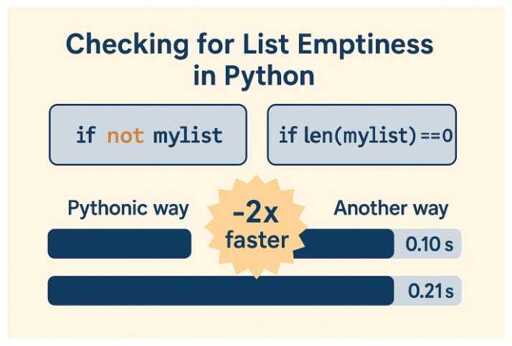
abhi9u@lemmy.world to Technology@lemmy.worldEnglish · 2 years agoPython Performance: Why 'if not list' is 2x Faster Than Using len()blog.codingconfessions.comexternal-linkmessage-square145linkfedilinkarrow-up1222arrow-down125
arrow-up1197arrow-down1external-linkPython Performance: Why 'if not list' is 2x Faster Than Using len()blog.codingconfessions.comabhi9u@lemmy.world to Technology@lemmy.worldEnglish · 2 years agomessage-square145linkfedilink
minus-squareFooBarrington@lemmy.worldlinkfedilinkEnglisharrow-up4·2 years agoThis is honestly the worst version regarding readability. Don’t rely on implicit coercion, people.
minus-squareantlion@lemmy.dbzer0.comlinkfedilinkEnglisharrow-up1·2 years agoBut the first example does the same thing for an empty list. I guess the lesson is that if you’re measuring the speed of arbitrary stylistic syntax choices, maybe Python isn’t the best language for you.
minus-squareFooBarrington@lemmy.worldlinkfedilinkEnglisharrow-up1arrow-down1·2 years agoYes, the first example does the same thing, but there’s still less to mentally parse. Ideally you should just use if len(mylist) == 0:.


This is honestly the worst version regarding readability. Don’t rely on implicit coercion, people.
But the first example does the same thing for an empty list. I guess the lesson is that if you’re measuring the speed of arbitrary stylistic syntax choices, maybe Python isn’t the best language for you.
Yes, the first example does the same thing, but there’s still less to mentally parse. Ideally you should just use
if len(mylist) == 0:.