A UC Berkeley researcher co-authored a study that raises profound questions about how we interact with artificial intelligence in education — and daily life.
This article is a perfect example of how legitimate research gets turned into sensationalist nonsense, and the post on Lemmy is making it worse.
The study involved 1,222 participants across three experiments. Researchers had people use AI to help with math and reading comprehension, then tested them when that assistance was removed. They found that participants were more likely to struggle with accuracy and persistence when they had to work independently.
That’s an interesting finding. It’s worth discussing.
But this whole fixation on “just 10 minutes” is ridiculous. Ten minutes of AI use under specific experimental conditions does not mean that ten minutes of ChatGPT permanently damages your brain or destroys your ability to think for yourself. The study did not demonstrate that.
There’s a pretty significant difference between showing that people can become reliant on assistance and struggle when that assistance is suddenly taken away, and claiming that AI use fundamentally erodes your cognitive abilities. One is an experimental finding. The other is an exaggeration of what that finding actually means.
And this is where I have a problem with the article and the way it’s being presented on Lemmy. The actual research is interesting enough without having to dress it up in sensationalist headlines. If the point is that people need to struggle with difficult problems to develop their skills, then make that argument. It’s a perfectly reasonable one.
But “using AI for 10 minutes erodes your ability to persist at hard things” is a hell of a lot more dramatic than what the research actually establishes.
There’s a difference between reporting scientific findings and manufacturing a narrative around them. We should be capable of discussing the potential downsides of AI without resorting to clickbait and misrepresenting what the research actually says.
Thank you! This makes me think maybe our brains reward themselves for finding easier ways to do something and LLMs become just that sometimes. But at the same time atrophying our existing skill. We need brain gyms like we do physical gyms.
Yeah my first thought looking at the title was literally… But I’m doing an extremely hard task while the dumb slop machine is doing an entirely different task.
I’m not just sitting there waiting around not thinking.
So how is that causing me to lose the ability to persist at hard things.
The article after reading it raises some good points but that head line is nonsense.
TLDR: LLMs are better information aggregators than Google, which has become a mess of ads and SEO spam. Using AI to complete homework isn’t inherently cheating; homework is practice, not an exam. If schools want to measure independent knowledge, they should use supervised assessments instead of take-home assignments. And if an assignment offers little educational value, perhaps the assignment is the problem, not the tool students use to complete it.
I think the more important takeaway from this study is that people produce better results when querying LLMs than when using traditional search engines. To me, that points to a problem with conventional search more than it demonstrates a detriment to using LLMs.
Have you tried Googling anything in recent years? It’s a bloody mess. Google increasingly prioritizes what it wants you to see, and more importantly, what advertisers have paid it to show you. Finding genuinely useful information has become an exercise in digging through sponsored results, SEO spam, and pages that exist primarily to generate ad revenue.
LLMs, for all their faults, are arguably better information aggregators at this point. That isn’t necessarily a ringing endorsement of AI, considering that they aren’t particularly good at searching either. It just illustrates how bad conventional search has become.
I wouldn’t interpret using an LLM to complete a task as inherently equivalent to students cheating. I’d argue that LLMs are simply another tool for finding, processing, and synthesizing information. If students can produce better results using those tools, perhaps we should be asking why we’re so determined to prevent them from doing so rather than examining the tools themselves.
And frankly, you can’t really cheat on homework. It’s homework, not a supervised examination. Students should be able to complete assignments using whatever resources are available to them. If the objective is to determine what students can accomplish independently, then schools should assess that through supervised examinations rather than take-home assignments.
More importantly, there’s a broader question about whether we’re assigning too much homework in the first place. Research has repeatedly found that its educational benefits depend on factors such as age, workload, and assignment quality. If an assignment provides little educational value beyond producing a completed worksheet, then perhaps the problem isn’t that students are using AI to complete it. Perhaps the assignment itself isn’t worth doing.
Kagi is able to reach into Japanese websites, aggregate their information, and translate a summary of the contents for me. I used it to learn a bit about an old SNES kusoge, called Saiya no Densetu. Apparently you can get Goku to arrive before the Ginyu Force fight, but paradoxically, he has to be very low level.
This is information that a traditional search engine can’t easily grasp and present.
They make browser extensions for translations, and my SearXNG can index Japanese sites. I use it to find and download obscure Japanese music albums and ROMs. AI is a very inefficient way to achieve that result.
Truth. There is a lot of obscure searches that would go nowhere if I tried to use old-school searching. AI is the way forward when it comes to collecting lots of info and giving a cliff notes. Even better, the AI can then go into detail.
AI is the glasses of the information world: it lets people focus on getting shit done, every day.
You used an AI service to determine if my comment was written by AI, and the service itself admits it can’t reliably determine that. Do you see the irony here? You literally used AI to guess whether I used AI and then treated that guess as fact. That’s some next-level nonsense.
I will say this however in my own defense not that I have to, I use Google keyboard which has a built-in AI editor it helps me to write long responses quickly.
I will use any and all tools that I deem necessary to complete any and all tasks regardless of your idiotic criticism.
Forgive me, but i’m not understanding why you find the headline to sensationalize or over state the actual findings of the study. The abstract of the paper directly says:
we provide causal evidence for two key consequences of AI assistance: reduced persistence and impairment of unassisted performance.
I’m struggling to discern a meaningful difference between “erodes your ability to persist at hard things” and “reduced persistence of unassisted performance”. Forgive me for not understanding but I would appreciate your explanation. The paper’s very own conclusion actually uses the term erosion:
Here, we show that AI interaction can result in significant impairments in independent performance and persistence – capacities that are foundational to life-long learning. If brief exposure produces measurable erosion, the cumulative effects of daily AI use over months or years may be profound and difficult to reverse
I found a definition of erosion: “the gradual loss of something as a result of an ongoing process”. Trust can erode and be rebuilt; soil can erode and be restored.
I agree that 10 mins of foundation model assistance likely doesn’t “permanently damage your brain or destroy your ability to think for yourself”. However, in my reading of the Berkeley news piece, I find no claim of this specific kind. Does the text of the press release explicitly claim the duration of effect is long-term or lasting? Does it explicitly claim the the erosion is permanent? Again, I find myself confused what you are arguing against.
Of course I’ll be happy to explain, the title of the article states:
Using Al for just 10 minutes erodes your ability to persist at hard things - Berkeley News
The findings of the study do not indicate that using an LLM (AI) for ten minutes removes your ability to do hard things. The study showed that it was harder to perform tasks without AI assistance after having access to it. In fact, people who used AI for ten minutes before performing difficult tasks actually performed better than those who did not.
The ten minutes was simply used as a control so that everyone had the same amount of time with AI. It had nothing to do with the erosion of their ability to perform difficult tasks. The conclusion the researchers drew, which is up for interpretation, was that prolonged AI usage may potentially impair people’s ability to perform harder tasks without assistance.
The title heavily implies that just ten minutes of AI usage makes difficult tasks harder to perform, which is not what the study showed or concluded. Therefore, the title has been intentionally sensationalized as clickbait. It objectively misrepresents the findings by encouraging a different interpretation and conclusion than what the study actually demonstrated.
The study itself is interesting, but apparently, the researchers’ findings weren’t sensational enough on their own. The people posting these articles still felt the need to mislead their audiences into drawing a different conclusion from the one the research actually supports.
“The study doesn’t show it removes the ability to do hard things”
Again, who exactly are you arguing against? Nobody said this… Neither the press release nor I
“People who used AI for ten minutes before performing difficult tasks actually performed better than those who did not.”
I’d gently encourage a quick re-read of the paper, as the statistic results directly contradict your claim. Here’s experiment 1 (fraction math problems):
The solve rate measures the rate at which the participants correctly solved the problem, and the skip rate measures the rate at which the participants chose to skip the problem rather than inputting an answer. We observe that with AI assistance (i.e., the first 12 problems), participants in the AI condition were significantly more likely to solve problems correctly and less likely to give up compared to the control participants. However, when the AI was removed, their performance dropped and they were also less likely to persist with problems (as seen by the increased skip rate).
Here’s experiment 2 (same fraction problems, but with an added pretest):
Finally, experiment 3 (SAT-style reading comprehension):
To clarify, people who used AI did worse than the people who never used AI on the test.
“The title heavily implies that just ten minutes of AI usage makes difficult tasks harder to perform, which is not what the study showed or concluded” and
Again, just to make sure we aren’t proceeding on a misunderstanding here, the headline says “persist”, which means to refusing to give up. The definition of persist is not that of perform. Further, I suggest you re-read the research paper. The abstract directly states, “impairment of unassisted performance”
“The conclusion the researchers drew, which is up for interpretation, was that prolonged AI usage may potentially impair people’s ability to perform harder tasks without assistance.”
I think you may be confused about how experimental studies work in research. In the experiment, when they controlled the variable of AI assistance, the experimental results showed statistically significant results proving the hypothesis that test solve rate of the control group was greater than the test solve rate of the AI group.
The results of the study are not in question, nor am I arguing against them. I am criticizing the sensationalist title being used in this Lemmy post.
The study does not say that using ChatGPT for 10 minutes erodes your ability to perform hard tasks. You yourself acknowledged this in the information you provided from the study.
So I guess the question is, what exactly are you arguing against?
Once again, to reiterate, my complaint is about the misleading clickbait title.
The vast majority of people who see this post aren’t going to read the study. They’re going to look at the title, nod their heads, and move on. I’m simply trying to provide some context.
Agreed, I tend to get more interested in topics and learn more than I expected, for new neural networks. I think it’s like any tool and using it right can be useful. Our brains can make new connections learning about different topics and how they are related, systems thinking and problem solving. We can search online and read the sources directly too, and verify more with increasing importance of the topic. For example, going to defend yourself in court, do a lot of research from quality sources and still reconsider lol. Just like large claims require large evidence, same idea for other resources including llms, and no need to avoid it like it’s some new Witch panic. The energy people use daily mindlessly absorbing video streams is more than text based llm use and follow up confirmations.
Learning new things and recognizing connections between topics is beneficial for the brain, as it strengthens neural pathways and enhances understanding. This process, known as neuroplasticity, allows the brain to adapt and improve its ability to learn over time



This article is a perfect example of how legitimate research gets turned into sensationalist nonsense, and the post on Lemmy is making it worse.
The study involved 1,222 participants across three experiments. Researchers had people use AI to help with math and reading comprehension, then tested them when that assistance was removed. They found that participants were more likely to struggle with accuracy and persistence when they had to work independently.
That’s an interesting finding. It’s worth discussing.
But this whole fixation on “just 10 minutes” is ridiculous. Ten minutes of AI use under specific experimental conditions does not mean that ten minutes of ChatGPT permanently damages your brain or destroys your ability to think for yourself. The study did not demonstrate that.
There’s a pretty significant difference between showing that people can become reliant on assistance and struggle when that assistance is suddenly taken away, and claiming that AI use fundamentally erodes your cognitive abilities. One is an experimental finding. The other is an exaggeration of what that finding actually means.
And this is where I have a problem with the article and the way it’s being presented on Lemmy. The actual research is interesting enough without having to dress it up in sensationalist headlines. If the point is that people need to struggle with difficult problems to develop their skills, then make that argument. It’s a perfectly reasonable one.
But “using AI for 10 minutes erodes your ability to persist at hard things” is a hell of a lot more dramatic than what the research actually establishes.
There’s a difference between reporting scientific findings and manufacturing a narrative around them. We should be capable of discussing the potential downsides of AI without resorting to clickbait and misrepresenting what the research actually says.
Thank you! This makes me think maybe our brains reward themselves for finding easier ways to do something and LLMs become just that sometimes. But at the same time atrophying our existing skill. We need brain gyms like we do physical gyms.
Yeah my first thought looking at the title was literally… But I’m doing an extremely hard task while the dumb slop machine is doing an entirely different task.
I’m not just sitting there waiting around not thinking.
So how is that causing me to lose the ability to persist at hard things.
The article after reading it raises some good points but that head line is nonsense.
“Students who cheat on their homework don’t learn as much” is a better headline.
TLDR: LLMs are better information aggregators than Google, which has become a mess of ads and SEO spam. Using AI to complete homework isn’t inherently cheating; homework is practice, not an exam. If schools want to measure independent knowledge, they should use supervised assessments instead of take-home assignments. And if an assignment offers little educational value, perhaps the assignment is the problem, not the tool students use to complete it.
I think the more important takeaway from this study is that people produce better results when querying LLMs than when using traditional search engines. To me, that points to a problem with conventional search more than it demonstrates a detriment to using LLMs.
Have you tried Googling anything in recent years? It’s a bloody mess. Google increasingly prioritizes what it wants you to see, and more importantly, what advertisers have paid it to show you. Finding genuinely useful information has become an exercise in digging through sponsored results, SEO spam, and pages that exist primarily to generate ad revenue.
LLMs, for all their faults, are arguably better information aggregators at this point. That isn’t necessarily a ringing endorsement of AI, considering that they aren’t particularly good at searching either. It just illustrates how bad conventional search has become.
I wouldn’t interpret using an LLM to complete a task as inherently equivalent to students cheating. I’d argue that LLMs are simply another tool for finding, processing, and synthesizing information. If students can produce better results using those tools, perhaps we should be asking why we’re so determined to prevent them from doing so rather than examining the tools themselves.
And frankly, you can’t really cheat on homework. It’s homework, not a supervised examination. Students should be able to complete assignments using whatever resources are available to them. If the objective is to determine what students can accomplish independently, then schools should assess that through supervised examinations rather than take-home assignments.
More importantly, there’s a broader question about whether we’re assigning too much homework in the first place. Research has repeatedly found that its educational benefits depend on factors such as age, workload, and assignment quality. If an assignment provides little educational value beyond producing a completed worksheet, then perhaps the problem isn’t that students are using AI to complete it. Perhaps the assignment itself isn’t worth doing.
Have LLMs become better than Google?
Or has Google just gotten shittier than LLMs?
My SearXNG instance never lies to me, and returns results better than Google used to before they fully enshitified
Kagi is able to reach into Japanese websites, aggregate their information, and translate a summary of the contents for me. I used it to learn a bit about an old SNES kusoge, called Saiya no Densetu. Apparently you can get Goku to arrive before the Ginyu Force fight, but paradoxically, he has to be very low level.
This is information that a traditional search engine can’t easily grasp and present.
They make browser extensions for translations, and my SearXNG can index Japanese sites. I use it to find and download obscure Japanese music albums and ROMs. AI is a very inefficient way to achieve that result.
LLMs are better at most search tasks than Google has ever been. No contest, it is in no way close.
Truth. There is a lot of obscure searches that would go nowhere if I tried to use old-school searching. AI is the way forward when it comes to collecting lots of info and giving a cliff notes. Even better, the AI can then go into detail.
AI is the glasses of the information world: it lets people focus on getting shit done, every day.
I disagree
Weak.
Seems you’ve been cooking for longer than 10 minutes…
Lol, offloading your lack of criticism of a point to an llm.
It shows 100% for Frankenstein
Read the text of the post. Are you admitting you can’t distinguish LLM output when you see it?
deleted by creator
Eh. Go sit and spin.
Now say it without crying.
Imagine needing a computer to put your own thoughts into words for you.
You used an AI service to determine if my comment was written by AI, and the service itself admits it can’t reliably determine that. Do you see the irony here? You literally used AI to guess whether I used AI and then treated that guess as fact. That’s some next-level nonsense.
I will say this however in my own defense not that I have to, I use Google keyboard which has a built-in AI editor it helps me to write long responses quickly.
I will use any and all tools that I deem necessary to complete any and all tasks regardless of your idiotic criticism.
“Using a compiler for ten minutes erodes your ability to write raw machine code”
This is… Unfortunately completely true. ☹️
Forgive me, but i’m not understanding why you find the headline to sensationalize or over state the actual findings of the study. The abstract of the paper directly says:
I’m struggling to discern a meaningful difference between “erodes your ability to persist at hard things” and “reduced persistence of unassisted performance”. Forgive me for not understanding but I would appreciate your explanation. The paper’s very own conclusion actually uses the term erosion:
I found a definition of erosion: “the gradual loss of something as a result of an ongoing process”. Trust can erode and be rebuilt; soil can erode and be restored.
I agree that 10 mins of foundation model assistance likely doesn’t “permanently damage your brain or destroy your ability to think for yourself”. However, in my reading of the Berkeley news piece, I find no claim of this specific kind. Does the text of the press release explicitly claim the duration of effect is long-term or lasting? Does it explicitly claim the the erosion is permanent? Again, I find myself confused what you are arguing against.
Of course I’ll be happy to explain, the title of the article states:
The findings of the study do not indicate that using an LLM (AI) for ten minutes removes your ability to do hard things. The study showed that it was harder to perform tasks without AI assistance after having access to it. In fact, people who used AI for ten minutes before performing difficult tasks actually performed better than those who did not.
The ten minutes was simply used as a control so that everyone had the same amount of time with AI. It had nothing to do with the erosion of their ability to perform difficult tasks. The conclusion the researchers drew, which is up for interpretation, was that prolonged AI usage may potentially impair people’s ability to perform harder tasks without assistance.
The title heavily implies that just ten minutes of AI usage makes difficult tasks harder to perform, which is not what the study showed or concluded. Therefore, the title has been intentionally sensationalized as clickbait. It objectively misrepresents the findings by encouraging a different interpretation and conclusion than what the study actually demonstrated.
The study itself is interesting, but apparently, the researchers’ findings weren’t sensational enough on their own. The people posting these articles still felt the need to mislead their audiences into drawing a different conclusion from the one the research actually supports.
“The study doesn’t show it removes the ability to do hard things” Again, who exactly are you arguing against? Nobody said this… Neither the press release nor I
“People who used AI for ten minutes before performing difficult tasks actually performed better than those who did not.” I’d gently encourage a quick re-read of the paper, as the statistic results directly contradict your claim. Here’s experiment 1 (fraction math problems):
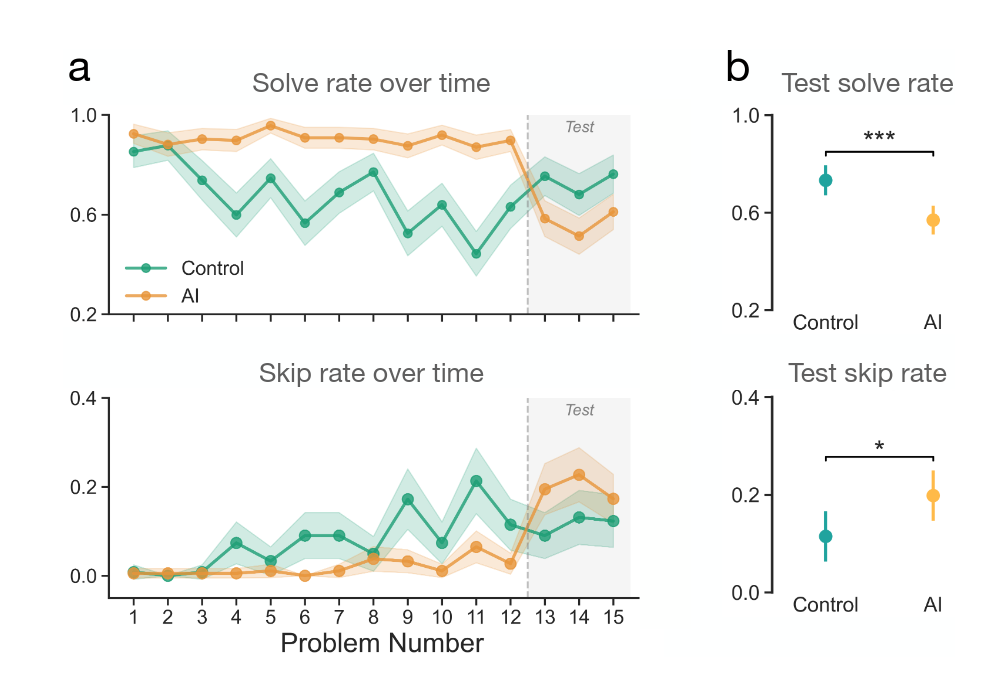
“The title heavily implies that just ten minutes of AI usage makes difficult tasks harder to perform, which is not what the study showed or concluded” and Again, just to make sure we aren’t proceeding on a misunderstanding here, the headline says “persist”, which means to refusing to give up. The definition of persist is not that of perform. Further, I suggest you re-read the research paper. The abstract directly states, “impairment of unassisted performance”
“The conclusion the researchers drew, which is up for interpretation, was that prolonged AI usage may potentially impair people’s ability to perform harder tasks without assistance.” I think you may be confused about how experimental studies work in research. In the experiment, when they controlled the variable of AI assistance, the experimental results showed statistically significant results proving the hypothesis that test solve rate of the control group was greater than the test solve rate of the AI group.
The results of the study are not in question, nor am I arguing against them. I am criticizing the sensationalist title being used in this Lemmy post.
The study does not say that using ChatGPT for 10 minutes erodes your ability to perform hard tasks. You yourself acknowledged this in the information you provided from the study.
So I guess the question is, what exactly are you arguing against?
Once again, to reiterate, my complaint is about the misleading clickbait title.
The vast majority of people who see this post aren’t going to read the study. They’re going to look at the title, nod their heads, and move on. I’m simply trying to provide some context.
This is a really smart take on things.
Yah this should be pinned
Yah. Turtally.
Agreed, I tend to get more interested in topics and learn more than I expected, for new neural networks. I think it’s like any tool and using it right can be useful. Our brains can make new connections learning about different topics and how they are related, systems thinking and problem solving. We can search online and read the sources directly too, and verify more with increasing importance of the topic. For example, going to defend yourself in court, do a lot of research from quality sources and still reconsider lol. Just like large claims require large evidence, same idea for other resources including llms, and no need to avoid it like it’s some new Witch panic. The energy people use daily mindlessly absorbing video streams is more than text based llm use and follow up confirmations.
Seems like a biased study yea. Why not get someone to do something manually first without AI, then give them AI to see if they do it better or worse?